Posted in Teaching with Temprano

A Field Trip, a Spark, and a Shift in Perspective

Students learn from you and their peers.

“That could be an artifact journal!” one of my students exclaimed with pride during our annual 5th-grade field trip. I paused, smiled, and thought, I wish I had recorded that moment.

It was more than just a student noticing something remarkable—it was a sign that our work in the classroom was alive and real to them. In that moment, I realized just how powerful intentional writing experiences could be. And yet, too often, the daily grind of teaching makes moments like that feel few and far between.

Between lesson planning, behavioral challenges, and the push to meet academic benchmarks, not to mention the ever-looming presence of AI that makes copy-paste answers far too tempting, it can feel almost hopeless to teach writing. I know the feeling well.

For years, I’d drag myself home, totally drained, with a pile of essays waiting in Google Classroom (or stacked in paper form). After COVID, I stepped into an Interventionist role, working specifically to raise NJSLA-ELA test scores, especially the daunting Writing About Reading section.

I went searching for the best strategies, the most impactful projects. But in that search, something unexpected happened: I circled back to the beginning.

Before I became a classroom teacher, I was already an interventionist, bright-eyed and full of promise. Back then, I created a tool to help my students discuss books meaningfully—and then turn those conversations into thoughtful, reflective writing.

I dug up my old notebooks. There were doodles, diagrams, and examples from a time when I believed anything was possible. And you know what? The results I saw with my students back then were incredible. Even the most hesitant writers were producing rich, meaningful work.

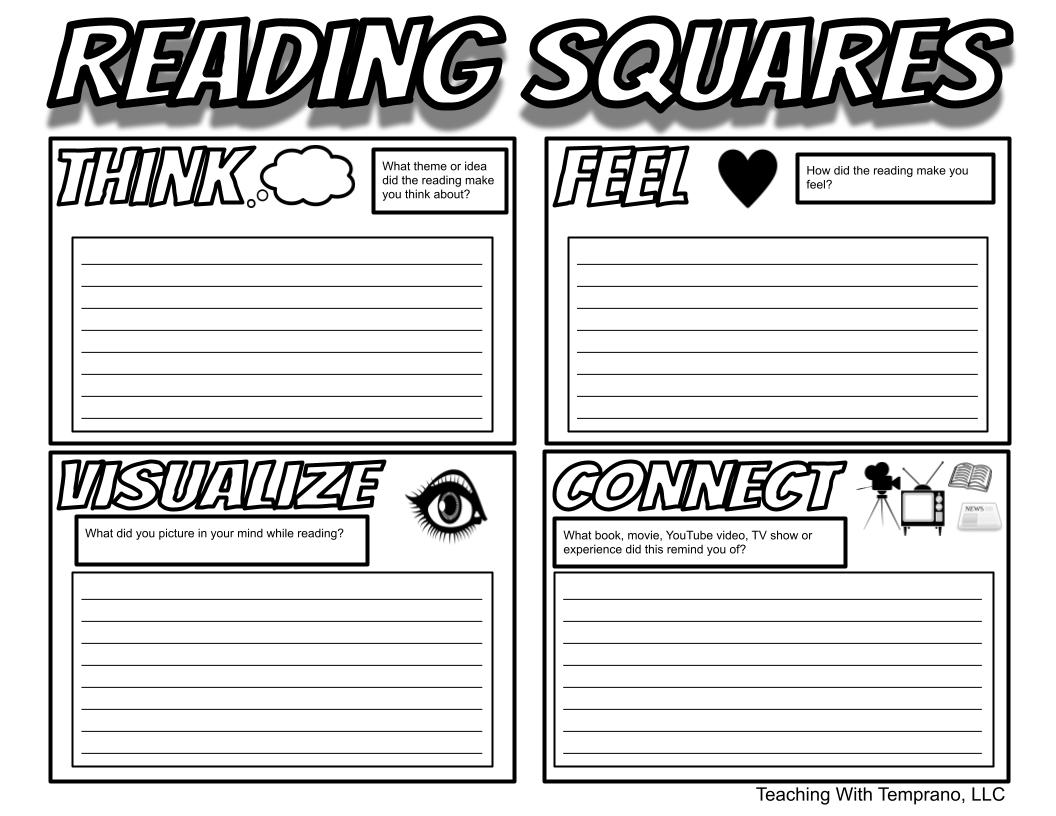
Reading Squares was the strategy. It helped my students understand what they read, talk about it using academic language, and then write about it with confidence.

And it’s still working.

Reading Squares saved my students. It helped them find their voice on the page—and it can do the same for yours.

But one question kept tugging at me: Are my students really reluctant? That term implies disinterest or unwillingness. But the kids I work with? They care. They want to understand what they read. They want to write more. Many of them beg for extra time to journal, to craft their stories, to respond to literature in meaningful ways.

They’re not reluctant.

They’re striving.

Striving captures what’s really going on: they’re reaching, pushing, and working toward grade-level success. They’re not passive; they’re engaged and hungry for tools that actually help.

So here’s my challenge to you: replace the word’ reluctant’ with ‘striving’ in your mind and in your classroom. Say it out loud. Write it in your notes. Watch how your own perspective shifts.

These kids aren’t stepping back from the challenge—they’re stepping into it.

And we owe it to them to meet them there.


Want to learn more about Reading Squares and how they can transform your students’ writing? Stick around—more tips, tools, and classroom stories are coming your way.

Teaching with Temprano is an Educational Consulting company whose sole purpose is to collaborate, educate, inspire, and provide real-world ELA strategies and lessons that you can use with your students tomorrow. Districts that wish to hire me for PLCs or PD workshops, email me at teachingwithtemprano@gmail.com
Posted in Teaching with Temprano

Could a Cohesive ELA Strategy Improve Your District’s NJSLA-ELA Scores?

Hint: Yes—and it can also transform your classroom community.

As educators, we carry the dual responsibility of preparing students for high-stakes tests while also helping them fall in love with learning. In ELA classrooms, that often means navigating the tightrope between test prep and authentic writing experiences. But what if we didn’t have to choose?

At Teaching with Temprano, we believe that a strategy grounded in student voice and academic conversation can do both—raise scores and create joyful, engaged writers.


A Strategy Built in the Classroom, Not a Conference Room

This is not a scripted curriculum or one-size-fits-all program. It is a writing strategy built with real students—tested in classrooms from grades 3 to 8, refined daily, and driven by what actually works for reluctant and struggling writers.

By modeling and practicing academic conversations and using a cohesive writing process, students learn to engage deeply with complex texts and articulate their thoughts through writing. The results?

✅ 3–5% gains in overall NJSLA-ELA scores
✅ 5–10% growth for struggling and reluctant readers and writers
✅ Classrooms where student voices shine, and ideas thrive


Why This Matters for Your District

Whether you’re leading a single school or a full district, implementing a unified writing strategy helps teachers align their instruction and gives students a clear, consistent approach to academic writing.

It’s not just about the scores, although the data is promising. It’s about equipping students with the skills and confidence they need to become lifelong thinkers, readers, and writers.


Professional Development That Meets You Where You Are

I’m a full-time teacher and a Teacher Consultant with the National Writing Project, which means I’m still in the trenches—and every strategy I share is rooted in lived classroom experience.

Here’s how we can work together:

✏️ Professional Learning Community (PLC) Facilitation

Collaborative, tailored sessions to align teacher practice and boost instructional impact across grades.

📚 Dynamic Workshops

Hands-on, engaging training focused on writing instruction that works for teachers and students.

🗂️ Curriculum Design Support

Custom pacing guides and writing units that center student voice and improve performance on writing assessments.


Let’s Connect

Interested in exploring how this strategy could support your district’s goals?

I’m currently available for a 1:1 consultation:

🕗 Now through June 18:
Mondays–Thursdays, 8:00–8:20 AM and 3:30–5:00 PM

🕣 After June 18:
Mondays–Thursdays, 8:30 AM–3:00 PM

Together, we can raise scores and build confident, joyful writers in the process.

Teaching with Temprano is an Educational Consulting company whose sole purpose is to collaborate, educate, inspire, and provide real-world ELA strategies and lessons that you can use with your students tomorrow. Districts that wish to hire me for PLCs or PD workshops, email me at teachingwithtemprano@gmail.com

Posted in Teaching with Temprano

National Poetry In Your Classroom

April is National Poetry Writing Month, and poetry is celebrated nationwide in various ways. Open Mics feature new and seasoned poets reading or reciting poetry they have written. Poetry prompts pop up on your Instagram feed and are emailed to your inbox.

As adults, we choose which activities speak to us. We select a poetry reading, write our own poetry, post on Substack, or read one of our favorite poets for inspiration or motivation.

Research shows that writing or reading poetry can benefit preadolescents and adolescents who are dealing with an illness or some form of adversity. A 2021 study done by doctors at the Rhode Island Hospital/Hasbro Children’s Hospital found “that providing opportunities for them (hospitalized children) to read and write poetry reduced their fear, sadness, anger, worry, and fatigue.” (Chung, Delamerced, Monteiro, and Panicker, 2021)

How can we implement strategies and techniques to help students cultivate their emotions and feelings productively? We teach them different types of poetry that explore feelings and sensory details, creating images connected to memories.

I have observed a tendency in elementary school classrooms to focus ONLY on poetry in April, and the poems are typically the same few: Acrostic, Haiku, and Diamante.

Acrostic Poems are the easiest, especially if the students only write a word or phrase for each line. Instead, try having them write a list poem or Anaphora. List poems are catalog poems designed to list names, places, objects, thoughts, and images in a cohesive manner. Famous list poems include Homer’s Iliad, Allan Ginsberg’s Howl, and Walt Whitman’s Song of Myself.

As elementary educators, we know that those are not the most useful examples for students. These are references for adults. Try this lesson.

✏️ Choose a topic. (Spring, Favorite Possession, Favorite Place, Favorite Holiday, or any random object from a novel you are reading with the class.)
📝 Students list everything that object, place, holiday, or season reminds them of in words and phrases. Include how it makes them feel.
📝 In groups or small groups, students revise their phrases and words into a poem, using commas or slash marks.
✏️ Students type the final poem and include a picture.

The complete Lesson Plan is attached, with links to “I am From” by George Ella Lyon and “Sick” by Shel Silverstein: https://docs.google.com/document/d/1K_fLGN9QJjS5hQ40CDTx6qhesYlIuAFIHGDTdBVpibo/copy

Teaching with Temprano is an Educational Consulting company whose sole purpose is to collaborate, educate, inspire, and provide real-world ELA strategies and lessons you could use tomorrow with your students. Districts that wish to hire me for PLCs or PD workshops email me at teachingwithtemprano@gmail.com