
Sentence Carousel Revising Station Strategy

One of the challenges of teaching writing with students in the upper elementary grades (3-5) is their frustration during the revising process. It can be a challenge for the teacher as well because it feels as though there is not enough time in the day or even the week to accomplish the revisions process.
Sentence Carousel is a unique and fun way to engage the students in the revision process without the feeling of failure on the part of the students.
I began with the idea of a carousel because my aim was to circle the students around the room, moving through from start to finish, allowing for the revision process of one sentence. It took me a few times to get my perfected method, but it works and the students love it!
I start with the question to the students: How can we improve our sentences in our essays? Let’s practice with sentences that are plain but not ours. (Typically my students are excited because it takes the pressure off their writing for the moment)
Here are the ten sentences I use for practice. I typically have the students work on two sentences for the first week. Then for each essay I assign (one per week), students practice with two sentences, then choose one from their essay and follow the same revision process with their writing partner. After the ten sentences for practice are used, the students begin writing the plain sentences during our debriefing form their own writing or one that they come up with on the spot.
To set this up, take five pieces of chart paper and strategically place them around the room, either on the walls or at their tables, whichever you prefer in your space. At the top of each paper, write the following:
Add an adjective.
Add an action word.
Add a “why” phrase.
Add sound.
Add a thought.
Write the simple sentences on separate pieces of paper attached to a clipboard. Here are the sentences I use for practice, but feel free to use your own if you would prefer.
I found a box in my attic.
Then we went home.
I took a ride on a flying carpet.
I did my homework.
We went to the beach.
My aunt gave me a doll.
We ate in a restaurant.
We went to the zoo.
I saw a strange dog.
A spaceship landed on the playground.
Students are grouped according to whichever method you prefer, but groups should be no larger than five. Each group receives the clipboard with the sentences at the top of each paper and a pen or pencil, depending on the grade level. If you are doing this with a smaller group, students can work with a partner and work through all five sections.
Each section or station lasts no more than five minutes. You can use a doorbell, chimes, bell, or any other sound to indicate the students move to the next station.
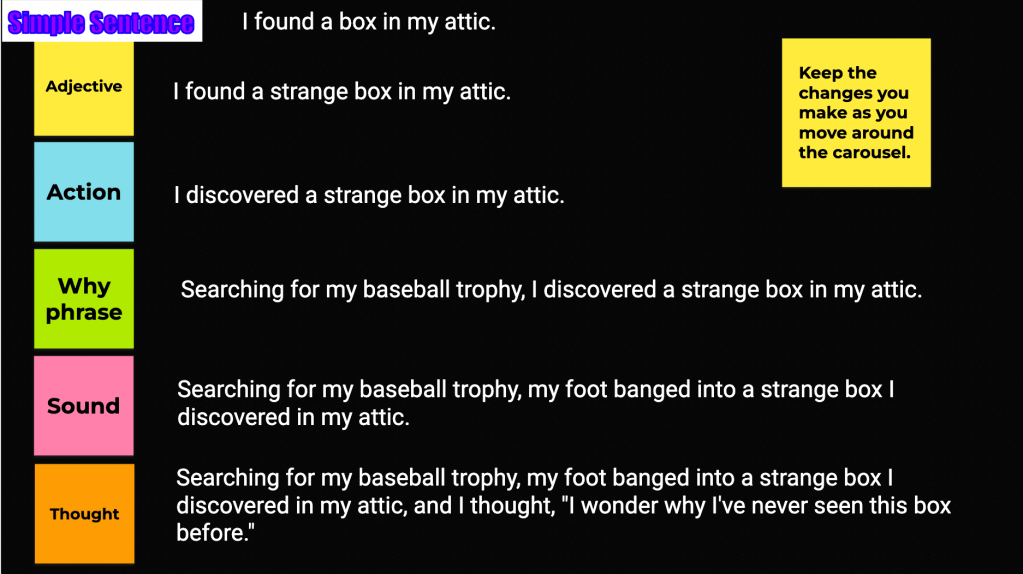
Here is what it looks like on the clipboard in my classes.
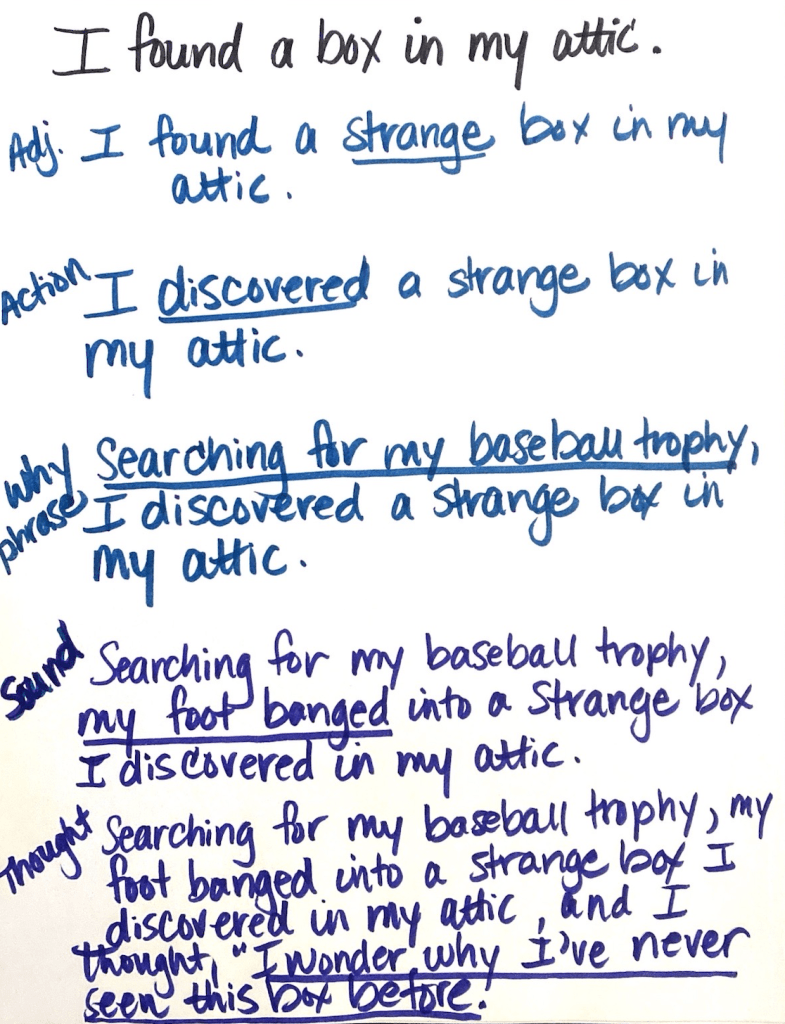
Assessment – Typically, I assess these informally with a Star, Check or Check Plus, Stamp, or any sticker. You can also assess this using a one-point rubric, but be careful with assessing with grades. The purpose of this strategy is to build confidence with revising skills. After the first ten sentences are completed, usually after the first marking period, that’s when I begin assessing and prompting with, “Don’t forget to use the sentence carousel with at least two-three of your sentences.”
Extensions: Students can make this into a one-pager or comic strip and post these in the hallways or on a Sentence Bulletin Board.
I would love to come and show you how this can be done in your classroom! Contact me for an appointment.

Teaching with Temprano is an Educational Consulting company whose sole purpose is to collaborate, educate, inspire and provide real-world ELA strategies and lessons you could use tomorrow with your students. Districts that wish to hire me for PLCs or PD workshops, email me at teachingwithtemprano@gmail.com

 Teaching with Temprano